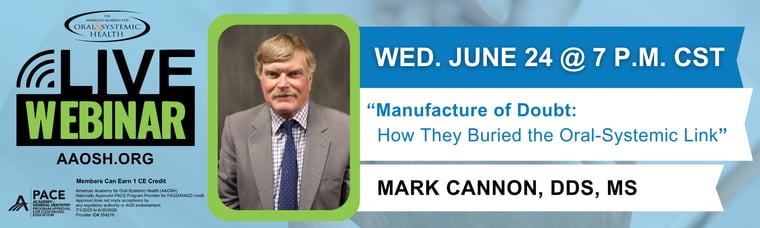
Presented by: Mark Cannon, DDS, MS
Original Lecture/ Publication Date: June 24, 2026 (Webinar Series)
| Take the Course - Coming Soon | This course is available for CE Credit as a "Members Only" benefit. Not a Member? CLICK HERE to learn more about AAOSH Membership. |
Course Description:
The relationship between oral health and systemic disease is not an emerging hypothesis. It is a mature, replicated, mechanistically characterized body of evidence spanning more than three decades of peer-reviewed research. Porphyromonas gingivalis gingipains have been detected in the postmortem brain tissue of Alzheimer's disease patients. Fusobacterium nucleatum is present in more than 50% of colorectal tumor specimens and travels with metastases. Periodontal disease confers a preterm low birth weight risk comparable in magnitude to smoking during pregnancy. Treponema denticola and P. gingivalis have been identified in atherosclerotic plaques, with carotid intima-media thickness directly correlated with periodontal pathogen load independent of traditional cardiovascular risk factors.
Why, then, does the average cardiologist not ask about periodontal disease? Why does the average obstetrician not screen for periodontitis? Why does the average neurologist not consider salivary pathogen burden in the differential diagnosis of cognitive decline? The answer is not scientific — it is structural, political, and, in part, manufactured.
This lecture traces the suppression of the oral-systemic link through three documented mechanisms: professional siloing, in which the administrative separation of dentistry from medicine created a clinical firewall against integration; industry-funded doubt, in which the sugar industry applied the tobacco industry's counter-research playbook to challenge oral-systemic associations as unproven while leaving its products unchanged; and diagnostic suppression, in which validated salivary biomarkers — including IL-1β, MMP-8, P. gingivalis DNA quantification, and pH have remained locked in research settings rather than translated into accessible consumer and point-of-care tools.
The lecture draws on the SalivaDB dataset (15,000+ entries linked to 201 diseases), the Human Salivary Proteome, and landmark studies from Circulation, Science Advances, Genome Research, and the Journal of Periodontology to make the case that the barriers to oral-systemic integration have never been evidentiary. They have been commercial, regulatory, and structural, using the same architecture that delayed action on tobacco for four decades and on sugar for three.
Attendees will leave with a clear understanding of why progress has been slow, what the evidence actually says, and what clinical and advocacy tools are available now to accelerate integration — including the case for consumer-accessible salivary testing as the diagnostic feedback loop that was denied to patients, and the role of oral healthcare professionals in demanding its translation.
Learning Objectives:
- Identify and explain the three structural mechanisms: professional siloing, industry-funded manufactured doubt, and diagnostic suppression, that delayed clinical integration of the oral-systemic evidence base, and distinguish these structural barriers from genuine scientific uncertainty.
- Describe the pathophysiological pathways by which specific oral pathogens (P. gingivalis, F. nucleatum, S. mutans, T. denticola, T. forsythia) contribute to systemic disease outcomes, including cardiovascular disease, Alzheimer's disease, colorectal cancer, and adverse pregnancy outcomes, with reference to supporting peer-reviewed literature.
- Evaluate the current state of salivary diagnostic technology — including validated biomarkers accessible via point-of-care and mail-based testing — and articulate the clinical and public health case for translating these tools into patient-accessible, before-and-after dietary intervention monitoring.
Practical Applications:
- Add oral health screening to routine evaluations, especially for patients with cardiovascular, cognitive, pregnancy, or inflammatory health concerns.
- Strengthen medical-dental collaboration by creating referral pathways for patients who may benefit from periodontal evaluation and treatment.
- Incorporate salivary diagnostics when available to assess risk, guide interventions, and monitor oral-systemic health outcomes.

Speaker Bio:
Mark L. Cannon is a Professor Emeritus and Attending Physician at Ann and Robert H. Lurie Children’s Hospital, and he is also a Retired Professor of Otolaryngology in the Division of Dentistry, Northwestern University, Feinberg School of Medicine, and an Adjunct Professor at the University of Tennessee Health Science Center in Memphis, Tennessee. In addition to being the founder of Associated Dental Specialists of Long Grove (1981), he is the Research Coordinator of the Pediatric Dental residency program at Ann and Robert H. Lurie Children’s Hospital, Chicago, Illinois, and a member of both the International Association of Pediatric Dentistry and the American Academy of Pediatric Dentistry (Fellow and Diplomate).
Dr. Cannon has 45 years of experience in pediatric dentistry and has presented national and international lectures. Dr. Cannon has presented guest lectures at the University of Athens, Greece; Sao Paulista State University, UNESP, Aracatuba, Brazil; University of Texas- Houston, University of Alabama-Birmingham; University of Michigan Ann Arbor, Yonsei University; Beijing Medical University; CES (Medellin, Colombia) and at the University of Illinois, Chicago, Department of Pediatric Dentistry. He has had presentations to the following organizations: I.A.D.R./A.A.D.R., the American Academy of Pediatric Dentistry, the American Society of Dentistry for Children, Academy of Dental Materials, World Congress of Biological Materials, International Association of Pediatric Dentistry, Pediatric Dental Association of Asia, Australasian Academy of Pediatric Dentistry, World Congress of Preventive Dentistry, Mexican Association of Pediatric Dentistry and the European Association of Pediatric Dentistry.
He lectures on many oral health topics, including evolutionary oral medicine, the gateway microbiomes, biological and bioactive dental materials (patent owner), probiotics, and all aspects of everyday pediatric oral and Systemic Health. He is a Master Fellow of the American Academy for Oral & Systemic Health, an Executive Board member, and was President (2023). Dr. Cannon has humbly accepted two invitations from the Karolinska Institutet, first to the Nobel Forum (2016) and secondly to the Nobel Assembly (2017). Most of all, Dr. Cannon is the proud father of five, all of whom are very accomplished, and a grandfather of six beautiful children.