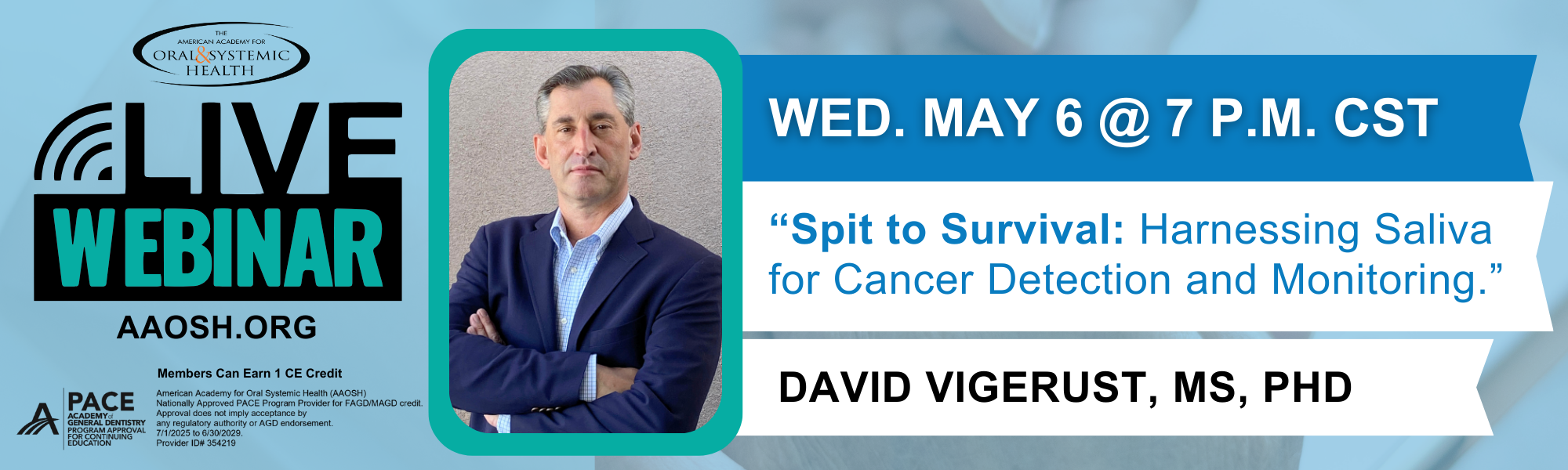
Presented by: David Vigerust, MS, PhD
Original Lecture/ Publication Date: May 6, 2026 (Webinar Series)
| Take the Course | This course is available for CE Credit as a "Members Only" benefit. Not a Member? CLICK HERE to learn more about AAOSH Membership. |
Course Description:
Saliva is rapidly emerging as a powerful diagnostic fluid with the potential to transform cancer detection, treatment planning, and monitoring. Unlike blood-based liquid biopsies, saliva offers a simple, non-invasive, and repeatable method for collecting clinically relevant biomarkers, including DNA mutations, RNA transcripts, proteins, metabolites, and exosomal cargo. Advances in molecular technologies such as EFIRM, salivary transcriptomics, and exosome analysis now allow clinicians to detect actionable cancer biomarkers with high sensitivity and specificity. This presentation will review the scientific foundations of salivary diagnostics, highlight clinical applications across the cancer continuum, and discuss the role oral-systemic health providers can play in integrating saliva-based testing into patient care pathways. Attendees will gain a deeper understanding of how this innovative diagnostic approach can enhance early detection, guide therapy, and improve survivorship outcomes.
Learning Objectives:
By the end of this lecture, participants will be able to:
- Explain the biological basis of saliva as a diagnostic medium, including its molecular and microbial components relevant to oncology.
- Identify key clinical applications of salivary diagnostics in cancer care, such as early detection, treatment stratification, and monitoring for recurrence.
- Evaluate case studies and breakthrough technologies (e.g., EFIRM for EGFR mutations, salivary HPV DNA for head & neck cancers).
- Recognize the advantages and limitations of saliva-based testing compared to blood-based liquid biopsies and imaging.
- Integrate oral-systemic perspectives into oncology care by positioning dentists and oral health providers as front-line screeners and referral partners.
Practical Applications:
- Incorporate saliva-based molecular testing as a non-invasive tool to support early cancer detection, treatment decision-making, and surveillance alongside existing diagnostic methods.
- Collaborate with dental and oral-systemic health providers to establish screening pathways that use salivary biomarkers for identifying high-risk patients and coordinating timely referrals.
- Utilize advances such as EFIRM, salivary transcriptomics, and exosome analysis to monitor therapy response or recurrence with greater frequency and patient comfort.
Speaker Bio:
Dr. David Vigerust holds a Bachelor's degree in Biology and Chemistry from the University of Texas at El Paso, a Master's degree in Microbiology and Immunology from Texas Tech University, and a Doctorate in Cellular and Molecular Pathology from Vanderbilt University School of Medicine. He conducted post-doctoral research at St. Jude Children's Research Hospital and completed a subsequent fellowship in Pediatric Infectious Disease at Vanderbilt University Medical School. Dr. Vigerust served as a faculty member in the Pathology, Immunology, and Microbiology Department at Vanderbilt University School of Medicine and as a Health Research Scientist in the U.S. Department of Veterans Affairs. As the former Chief Scientific Officer and VP of Immunology for various precision medicine and diagnostic laboratories, he developed innovative molecular diagnostic assays predicting inflammation and cardiovascular risks in diabetes, infectious disease, and cancer patients. Dr. Vigerust frequently lectures on precision medicine and has presented as a TEDx speaker.
AGD Course #:
730 (Oral Medicine, Oral Diagnosis, Oral Pathology)
Conflicts of Interest:
Affiliated with Spectrum Solutions/ SimplyPERIO