
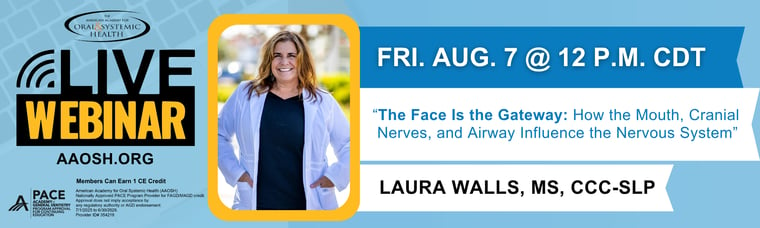
Presented by: Laura Walls, MS, CCC-SLP
Original Lecture/ Publication Date: August 7, 2026 (Webinar Series)
| Take the Course | This course is available for CE Credit as a "Members Only" benefit. Not a Member? CLICK HERE to learn more about AAOSH Membership. |
Course Description:
The face and mouth are often viewed through separate clinical lenses: speech, swallowing, dental development, facial aesthetics, TMJ, pain, or breathing. This presentation challenges that separation by introducing the mouth-face-brain connection as a major frontier in functional health, therapy, and performance. Participants will explore how the lips, tongue, jaw, palate, nasal airway, facial muscles, cranial nerves, and oral sensory-motor system serve as a gateway into the brainstem, autonomic regulation, airway protection, posture, pain, and performance.
The face is not cosmetic first; it is neurological first. Cranial nerves involved in oral function and swallowing include the trigeminal, facial, glossopharyngeal, vagus, accessory, and hypoglossal nerves. These systems support sensation, mastication, facial expression, tongue movement, airway protection, swallowing, voice, and regulation. The trigeminal system alone processes sensory input from the teeth, jaw, masticatory muscles, facial region, and oral structures, making it central to orofacial pain and brainstem-level sensory integration.
From a business perspective, this topic connects multiple expanding markets: neuromodulation, aesthetics, pain care, airway therapy, performance recovery, and noninvasive wellness technology. The neuromodulation market is projected to grow from $6.81 billion in 2025 to $10.68 billion by 2030, while the global aesthetic medicine market is projected to grow from $109.2 billion in 2026 to $240.0 billion by 2033. This presentation positions the oral-facial system as a clinically powerful bridge between neuroscience, function, beauty, airway, and human performance.
Learning Objectives:
- Describe the neurological connections between the oral-facial complex, cranial nerves, airway, and autonomic nervous system.
- Identify how dysfunction of the lips, tongue, jaw, palate, facial muscles, and airway can influence swallowing, pain, posture, breathing, and overall function.
- Discuss emerging clinical applications of oral-facial neurology in interdisciplinary care, including airway management, pain therapy, neuromodulation, and functional rehabilitation.
Practical Applications:
- Screen patients for oral-facial and airway dysfunction that may contribute to pain, impaired breathing, swallowing disorders, or altered nervous system regulation.
- Incorporate knowledge of cranial nerve function into patient assessments to improve interdisciplinary referrals and comprehensive treatment planning.
- Educate patients on how oral-facial function influences overall health and identify opportunities to integrate evidence-based therapies that support airway health, neuromuscular function, and long-term wellness
Speaker Bio:
Laura Walls, MS, CCC-SLP, is a licensed speech-language pathologist with over 30 years of experience specializing in pediatric rehabilitation, myofunctional disorders, and airway diagnostics. A graduate of UC Santa Barbara and CSU Hayward, she has worked across diverse clinical settings—from the VA Hospital in San Francisco to NICUs—focusing on feeding, speech, and cognitive disorders. Laura is the creator of the My Mouthworks® Program and inventor of the FDA-cleared Oral Placement Appliance® (OPA). Her work integrates whole-body approaches to address sleep-disordered breathing, TMJD, and myofunctional concerns in both children and adults.